Category: Nomadic Lifestyle & Coffee | Reading time: 8 min
Introduction
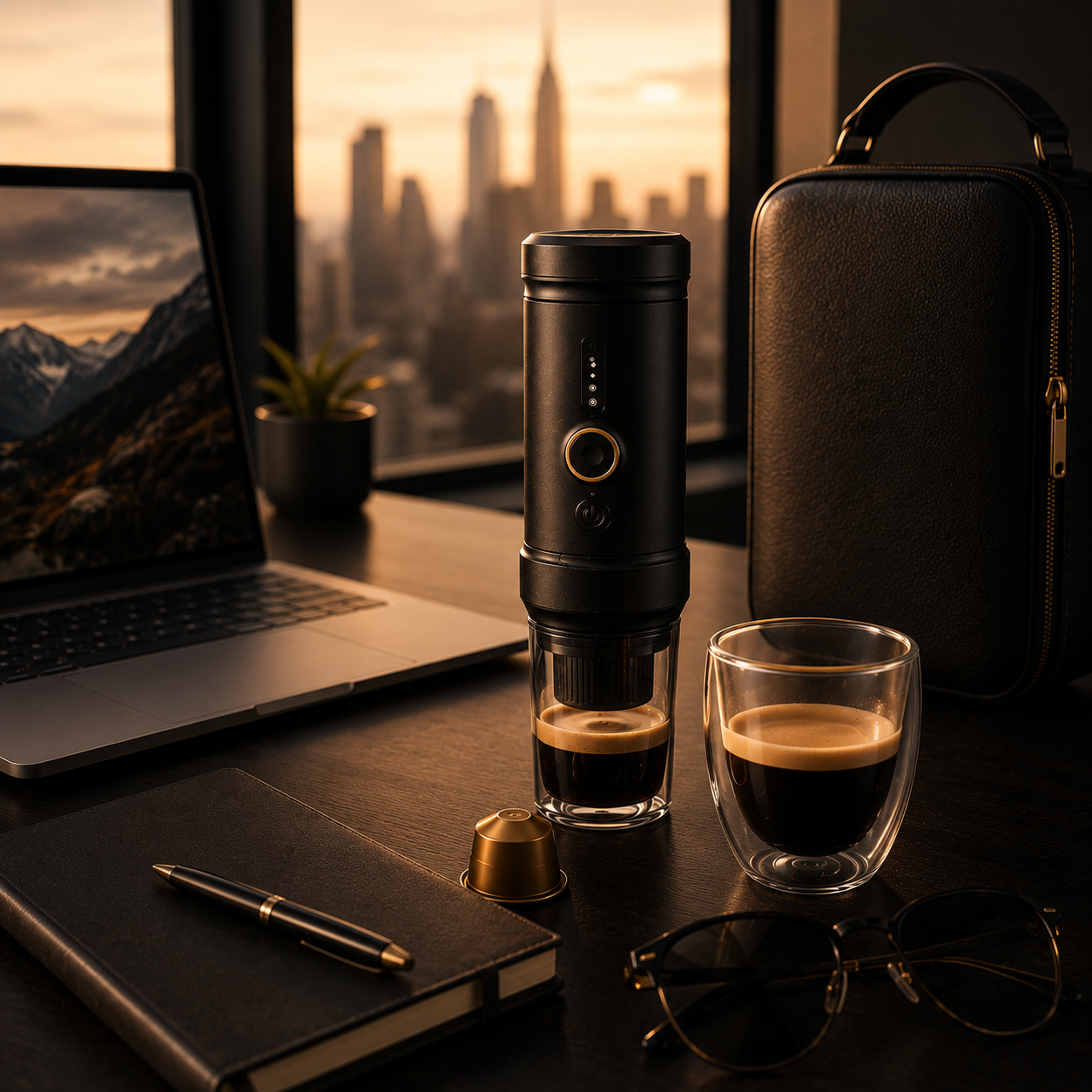
In 2026, millions of people are working from cafes, coworking spaces, Airbnbs in Lisbon, vans parked by the ocean, or living rooms converted into offices. Remote work is no longer an exception — it is a chosen lifestyle, fully embraced and optimized down to the smallest detail.
These professionals invest in their setup: a good computer, noise-canceling headphones, a reliable internet connection, an ergonomic desk. They think of everything. And yet, the vast majority of them still overlook a detail that directly impacts their productivity and daily quality of life: coffee.
A good coffee, prepared at the right time, by you, exactly how you like it — it's more than just a habit. It's an anchor, a signal to the brain that work is starting or that a break is well-deserved. And in 2026, the USB-C portable coffee machine is the tool that was missing from every serious nomadic setup.
This guide explains why — and how to choose the right model based on your exact profile.
Remote work changed everything — except the coffee
The remote work and digital nomad movement has revolutionized work organization. Remote workers can save between $600 and $6,000 per year thanks to reduced commuting and dining costs. But paradoxically, coffee remains one of the most poorly optimized expenses for nomadic workers.
The remote worker who sets up in a cafe pays for their seat by ordering 2 to 3 drinks — between €8 and €15 per session. The digital nomad renting an Airbnb often discovers a single Nescafé capsule left by the host. The employee on a business trip resigns themselves to the €4 hotel coffee at breakfast.
Each of these scenarios has a common solution: a rechargeable USB-C portable coffee machine. Lightweight, autonomous, and universally compatible, it follows the nomadic worker exactly like their laptop or headphones — and it transforms the coffee experience of every work session.
Why USB-C changes everything for the nomadic worker
Before the advent of the USB-C standard, portable coffee machines had a fundamental problem: they depended either on an electrical outlet or on manual pumping that required physical effort, which isn't very compatible with a busy work morning.
The USB-C charger changed everything. To understand why, just look at what a nomadic worker already carries: a USB-C charger for their laptop, a USB-C cable for their phone, and a USB-C power bank for long days. A rechargeable USB-C coffee machine fits into this existing system without adding a single extra cable, adapter, or charging block.
It is universal compatibility brought to coffee equipment.
In practice, this means you can recharge your coffee machine using:
- Your phone's power bank (the one already in your bag)
- Your laptop's USB-C port
- Your car or van charger
- Any standard outlet with a simple adapter
- Charging stations at airports, train stations, and coworking spaces
No extra equipment. No dependence on specific infrastructure. The espresso follows the worker wherever they go.
The 6 profiles of remote workers and digital nomads — and how the portable machine changes things for each
1. The home-based remote worker
They have a coffee machine at home — but it's in the kitchen, at the other end of the hallway from their makeshift office. In winter, getting up to make a coffee breaks the flow of concentration. In summer, the back-and-forth between the workspace and the kitchen represents dozens of minutes lost per week.
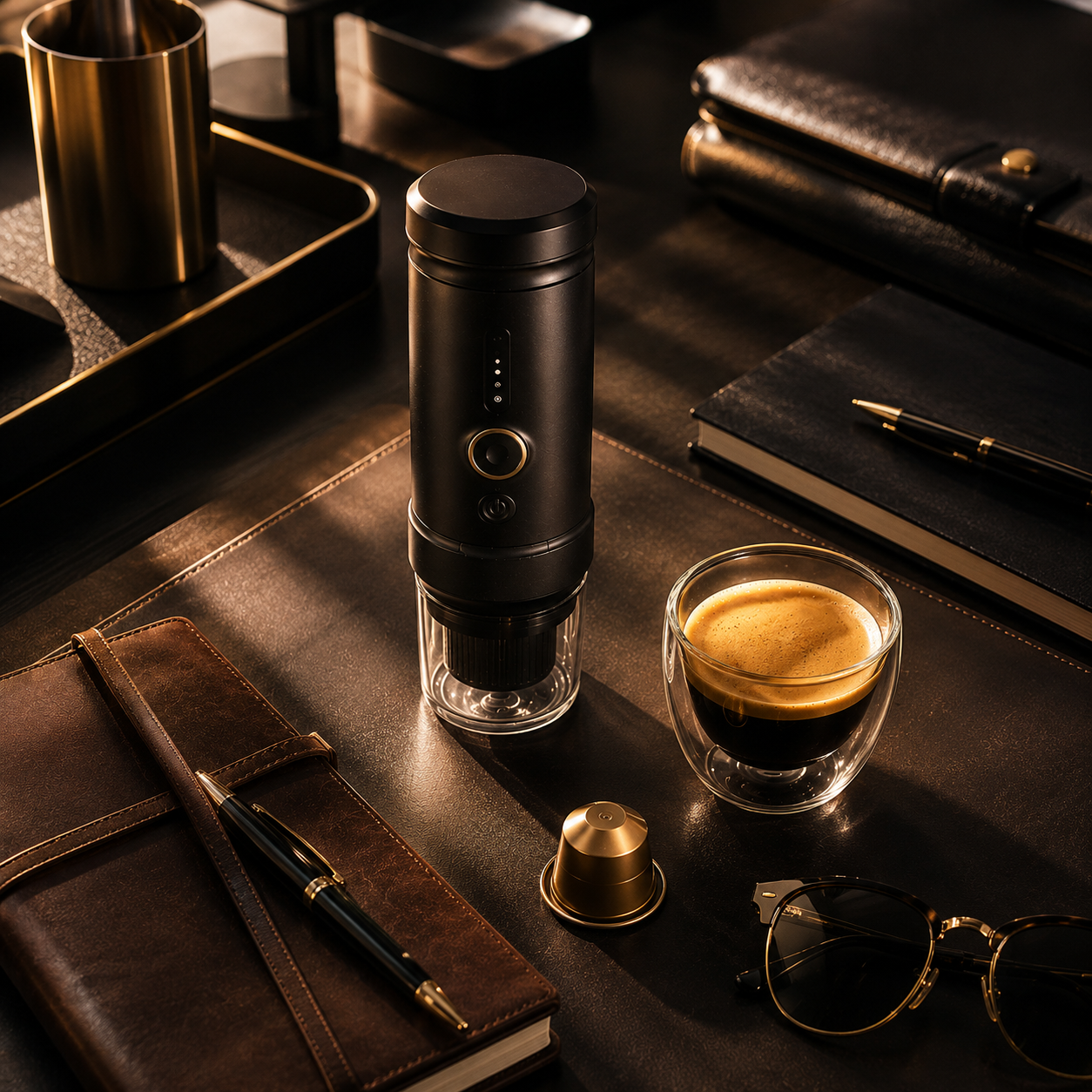
What changes:A portable coffee machine placed directly on the desk. The espresso is prepared without leaving the seat, without breaking the work rhythm, and without losing the thread of a meeting that has just started.
2. The coworking freelancer
They set up in different coworking spaces depending on the day and project. The communal coffee machine is shared by 50 people — questionable hygiene, hit-or-miss taste, and constant lines at 10 AM and 2 PM.
What changes:They arrive with their machine in their backpack. They use the communal space's kettle for hot water, slide in their capsule, and 45 seconds later, they have the best coffee on the floor. Other coworking members take notice. Some even ask for the brand.
3. The frequent business traveler
Consultants, sales reps, trainers, multi-site project managers — these professionals spend one or two nights a week in hotels. Hotel breakfast coffee costs between €3 and €6 per cup for often mediocre quality. Over 40 annual trips, that's between €120 and €240 spent solely on hotel coffee.
What changes:The portable coffee machine in the carry-on suitcase. In the morning, in the room, before the shower — an espresso prepared with their own capsules, at the right temperature, without waiting for breakfast service.
4. The traveling digital nomad
They work from different countries, change Airbnbs every 2 to 4 weeks, and adapt their setup to very diverse infrastructures. Coffee quality and availability vary enormously by destination — excellent in Italy or Portugal, catastrophic in some Asian or North American countries where espresso is not the norm.
What changes:Total independence from local coffee infrastructure. Whether the Airbnb is in Barcelona, Bali, or Berlin, the digital nomad has their USB-C espresso in their bag. They bring their coffee ritual to every new address.
5. The van lifer and motorhome owner
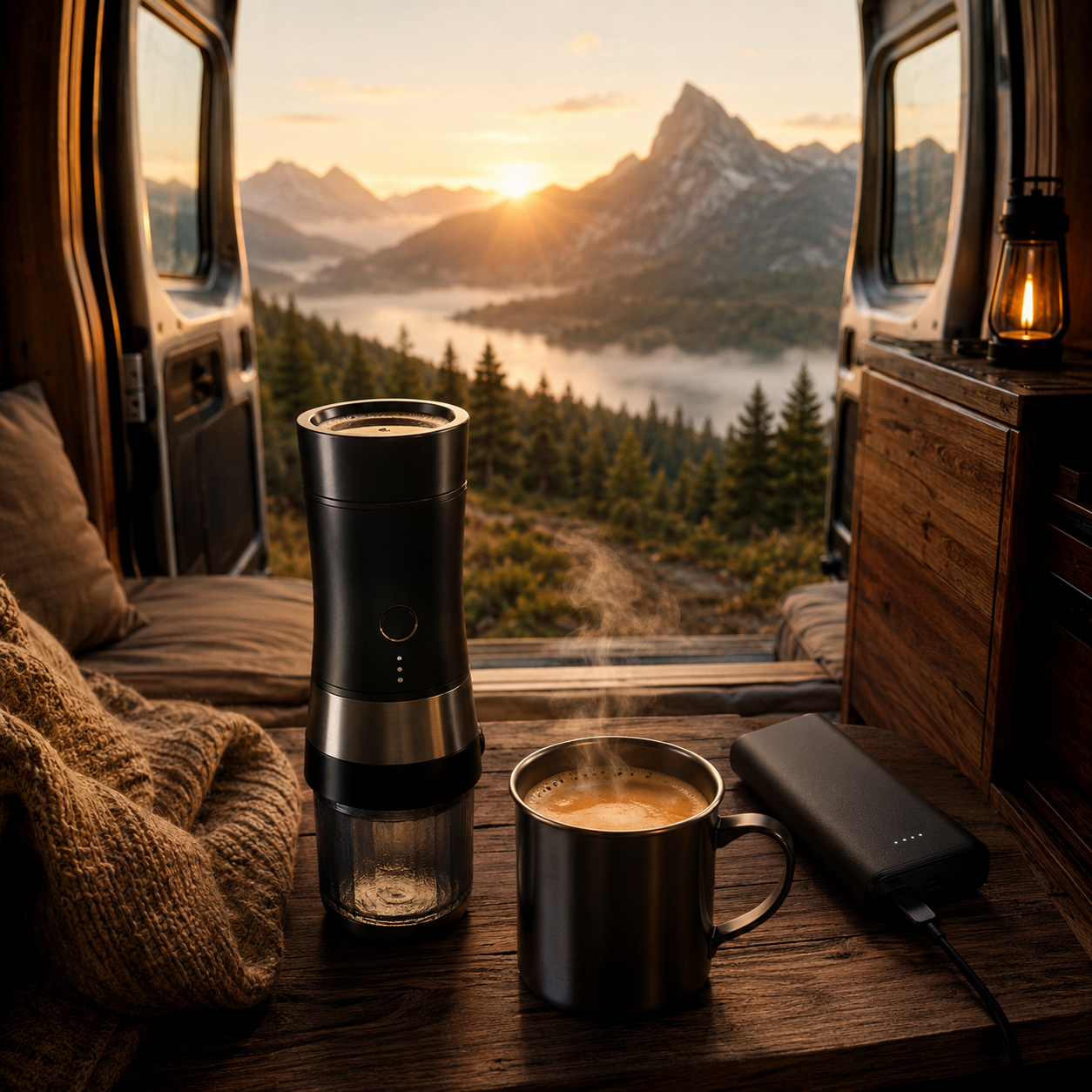
They live and work from their vehicle. Their mobile kitchen is functional for meals, but the coffee machine often represents a compromise between weight, space, and quality. Current solutions — camping percolators, French presses, stoves + grinders — require time and organization.
What changes:Rechargeable via the cigarette lighter or the van battery, and compatible with ground coffee (the most economical and widely available option), the USB-C portable coffee machine fits perfectly into a mobile life without adding significant logistical constraints.
6. The "deep work" entrepreneur
They practice deep work — intensive work sessions of 2 to 4 hours without interruption. For them, coffee isn't a break — it's a concentration tool. They prepare it before a session or mid-session without leaving the flow state. Every unnecessary interruption is a real loss of productivity.
What changes:The machine on the desk, coffee prepared in 45 seconds without leaving the room, without losing the train of thought. A detail that becomes a real cognitive advantage over time.
What you must check before buying
The market for USB-C portable coffee machines has grown considerably in 2025-2026. Not all models are created equal, and some use "USB-C" as a marketing buzzword without the actual battery life to back it up. Here is what differentiates the good models from the bad.
Real battery life vs. advertised battery life
A serious model should offer at least 6 espressos per full charge under normal conditions. Below 4, you'll be recharging the machine every two days — which cancels out part of the nomadic advantage.
Also check compatibility with standard power banks: some models require a higher USB-C power output than what typical phone batteries provide. A good model works with any power bank of 10,000 mAh or more.
Universal compatibility of coffee formats
A nomadic worker doesn't always control their access to supplies. In some countries, Nespresso capsules are hard to find. In others, ground coffee is everywhere but capsules are rare.
The solution: a 3-in-1 model compatible with Nespresso capsules, large capsules, and ground coffee. This versatility ensures you will always find a usable format, regardless of your destination.
Weight in the context of the total nomadic setup
A nomadic worker already carries 1.5 to 2.5 kg of equipment (laptop, charger, accessories). The coffee machine must stay under 400g to avoid significantly weighing down the bag. Beyond that, it starts to influence transport decisions, and the risk is that it stays at the hotel or in the suitcase rather than being used daily.
Real extraction quality
The key argument for a portable coffee machine isn't just convenience — it's quality. If the result is lukewarm coffee with no crema, the machine isn't worth its price, whatever that may be. A good portable machine maintains stable pressure throughout the extraction, producing real crema and aromas comparable to a coffee bar.
The economic calculation that justifies the investment in 30 seconds
Let's take the profile of a consultant traveling 2 days a week, 45 weeks a year:
- Hotel coffee in the morning: €4 × 90 nights = €360/year
- Coffee at coworking or cafes for work: €3 × 90 sessions = €270/year
- Total spent on coffee away from home: €630/year
Investment in a premium portable coffee machine : €139 one-time
Payback period: less than 2 months.
And this calculation doesn't even account for time lost waiting in line, the quality of the coffee obtained, or the comfort of preparing it at your own pace.
Why Velmora™ is the logical choice for this profile
Velmora™ was designed specifically for the profiles described in this guide. Not for home kitchen use — for daily nomadic use.
Its USB-C rechargeable battery compatible with any standard power bank, its 3-in-1 compatibility ensuring coffee access in any country, its 10-second cleaning process adapted to limited water access, and its pocket-sized format that disappears into any work backpack — each of these features addresses a real constraint of the nomadic worker.
It is a tool, not a gadget. And like any good tool, it is forgotten — until the moment you don't have it.
[→ Discover Velmora™ — Free Shipping · 60-Day Money-Back Guarantee]
Conclusion: The nomadic setup is incomplete without it
Nomadic workers and remote employees optimize every aspect of their work environment — connection, hardware, ergonomics, sound. Coffee remains the blind spot of most setups. In 2026, with a USB-C portable machine in your bag, that is no longer a valid excuse.
An espresso in 45 seconds. Anywhere. Without looking for an outlet, without waiting for a barista, without paying €4 for something you can do better yourself. It's the final upgrade your nomadic setup has been waiting for.
[→ Order Velmora™ now — Complete your nomadic setup]
Related articles: → [How to choose your portable coffee machine in 2026 — the complete guide] → [7 everyday problems a portable coffee machine solves] → [Portable coffee machine: the gift idea that truly surprises] → [The best capsules for portable coffee machines]
Article written by the Velmora™ team — Travel Baristas since 2024.

Leave a comment
This site is protected by hCaptcha and the hCaptcha Privacy Policy and Terms of Service apply.